
Mirzapur is a city in Uttar Pradesh, India, roughly 650 km from both Delhi and Kolkata, almost 87 kms from Allahabad and 67 kms from Varanasi. It has a population of 2,496,970 of which male and female were 1,312,302 and 1,184,668 respectively(via:-census2011). It is known for its carpets and brassware industries. The city is surrounded by several hills and is the headquarters of Mirzapur District and is famous for the holy shrine of Vindhyachal, Ashtbhuja and Kali khoh and also have Devrahwa Baba ashram.
It has many waterfalls and natural spots. It was once the largest district in Uttar Pradesh before the split up of Sonebhadra. There are a few cinema-halls. At first look the city appears to be a confluence of town, village and city life. Before the establishment of the town, the area was a dense forest and freely used by various states like Varanasi (A.K.A.:-Benaras), Sakteshgarh, Vijaygarh, Nainagarh (Chunar), Naugarh, Kantit and Rewa for Hunting.
British East India Company had established this area to fulfill the needs of a trading center between central and western India. This time Rewa was a well-established state of central India and was directly connected with Mirzapur by the Great Deccan Road.
Over the time Mirzapur became a famous trading center of Central India and started trading of cotton, and silk at very large scale. The East India Company named this place as Mirzapur. The word Mirzapur is derived from ‘Mirza’ which in turn is derived from the Persian term ‘Trip Kalchu which literally means “child of the ‘Amīr” or “child of the ruler”.
In Persia‘ Amīrzād in turn consists of the Arabic title ‘Amīr (English. “Emir”), meaning “commander”, and the Persian suffix -zād, meaning “birth” or “lineage”. Due to vowel harmony in Turkic languages, the alternative pronunciation Morza (plural morzalar; derived from the Persian word) is also used. The word entered English in 1595, from the French émir. The meaning of Mirzapur is the place of King.
AT A GLANCE
TEHSIL :
| S.No. | Tehsil |
| 1 | Sadar |
| 2 | Lalganj |
| 3 | Marihaan |
| 4 | Chunar |
DEMOGRAPHY
As per provisional population figures of 2011 Census, the details are as follows.
The calm and easygoing Mirzapur has never been known for its lifestyle and culture. This typical small-town of Uttar Pradesh is mostly known for its carpet weaving and brassware industries than for its festivals, food and remarkable tourist spot. For years, Mirzapur was merely a way station to the famous Chunar fort. Of late, however, the city is gaining popularity for its natural beauty and charming picnic spots. Despite a decent rise in its tourism, getting adapted to a vibrant city-life still remains a distant goal for Mirzapur.
The cultural life of Mirzapur can be coined as “Ganga-Jamuni” culture that is quintessentially rural with specks of urban life making a peek-a-boo. In Mirzapur you can get a taste of pastoral life with folk music, dance and poetry oozing out at every breath. Here, you see a pleasant concoction of two lifestyles – one with dhoti or gamchha (towel) and kurta and other with branded apparels and scents. It is interesting to watch how these two extreme cultural wont co-exist harmoniously.
Apart from the local Mirzapuri dialect, the attires of rural Mirzapur is also quite distinct with women wearing traditional jewellery like kada (bracelet), baju band (arm bands), hasli (thick neck rings), bichiya (toe rings), kanachadi (ear rings), kardhani (silver belt). Men are mostly seen in gamchha and kurta.
Mirzapur has its indigenous folk culture. Some of the popular folk genres are Kajali, Biraha, Lachari, Lavani are Belwariya. Biraha is an extremely popular folk genre that is based on romantic or chivalrous tales, stories on goddesses or contemporary issues. Competition between two Biraha parties is a common cultural programme in the area.
Festivals form an intrinsic part in the lives of Mirzapur residents. Ancient folklores, mythology as well as history play a big role in these festivals. Some of the important festivals organised in the city are Jeevitputrika, Ganesh Dashehra, Ojhala Ka mela, lalahi Chatth, Vasantik Navratra, Shardiya.
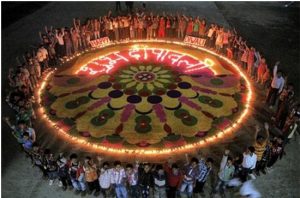
Celebrated on Kartik Amavasya or Diwali, locals on this day adorn the ghats of Ganges with beautiful diyas or lamps and enjoy the evening burning crackers.
Of all these festivals, Kajari Mahotsav is celebrated in the grandest of way possible. This festival is celebrated in remembrance of King Kantit Naresh’s daughter Kajali. It is locally said that Kajali loved her husband very much and she found it difficult to forget her husband even after their separation. During her lonely days, Kajali sang sad love songs remembering her husband. Her melodious voice was loved by every local residents of Mirzapur. After Kajali’s death, the entire district remembers her through Kajari festival.
The festival takes place every monsoon where handmade, colourful swings are hung on tree branches. The celebration continues for five consecutive days. Dwarkadeesh temple, Kunj Bhawan and Ganga Jamuna Saraswati temple are beautifully decorated on these five days.
Mirzapur is also for its numerous fairs. Lohandi mela, Ojhala Mela, litti bati ka mela, Horaha gaderi Ka Mela are the most popular ones.
The biggest attraction of Lohandi Mela is the artistic tattoo design stalls. The fair takes place adjacent to an old Lord Hanuman Mandir that is situated 2 km away from the main Mirzapur city. The temple is lit with earthen lamps during the entire monsoon period and along with several rituals performed, this fair is also organised for all Lord Hanuman devout.
A fair near Ujjala river is organised every year. This is the only fair in the country where betting is legal on days of the fair.